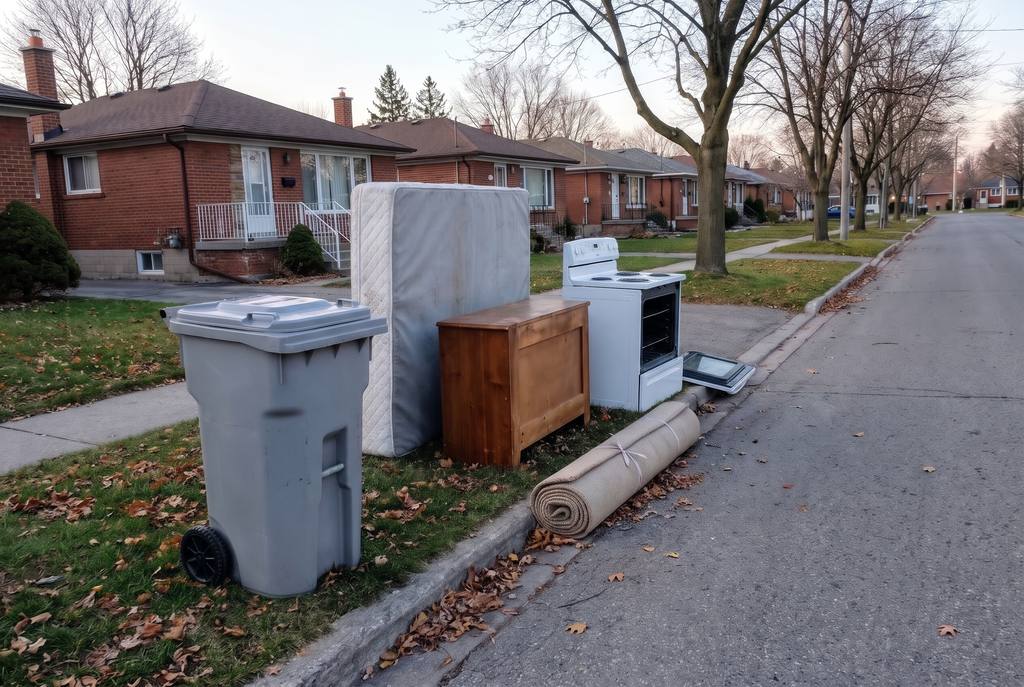
North York junk rules that affect your load
Renovation debris, paint and propane cannot go out with ordinary garbage, and large items have preparation and timing rules of their own.
Materials in a mixed load
A garage cleanout can contain a wardrobe, old kitchen cabinets and a shelf of paint cans in the same pile.
Toronto treats those as different kinds of waste, with renovation debris and hazardous products excluded from oversized curbside collection.
Putting the whole pile beside a bin does not make it one acceptable load.
The City can also refuse or limit the amount of special collection it gives an owner.
Send us the list before the items move, including anything heavy, liquid or still connected.
We need the floor, the stairs and the place a truck can stop as well as the contents of the pile.
Send the load details for a quote
Source: Toronto Municipal Code, Chapter 844, Waste Collection, Residential Properties
What cannot go in an ordinary curbside pile
Renovation waste
- Drywall, plaster and insulation
- Cabinets, countertops and bathtubs
- Doors, baseboards and lumber
- Fencing, roofing shingles, siding and tile
These are excluded from City oversized collection, so include the material and quantity in your removal request.
Hazardous products
- Paint, including empty paint cans
- Propane cylinders and fuel containers
- Motor oil, batteries and solvents
- Pesticides, pool chemicals and fluorescent tubes
These products must stay out of garbage, Blue Bin recycling, Green Bin organics and drains.
Extra disposal restrictions
- Tires are refused at City depots until further notice
- Concrete, brick, stone, soil and sod are refused at City depots
- Asbestos is refused at City depots and is not a load we take
Name these separately in the request so we can confirm what can be included and where it can go.
Preparation rules that catch people out
- Appliance doors and locks
- Before a fridge, freezer, washer or dryer is set out for City collection, its doors and locks must be removed.
- Ovens and other appliances
- The City also tells residents to remove oven doors, and the collection by-law makes removing appliance doors the owner's duty.
- Carpet and underpad
- Carpet must be rolled, cut and tied into bundles no longer than four feet and no heavier than 20 kilograms, so a room of carpet can mean several separate bundles.
- Sofa beds
- The City requires the folded bed frame to be tied down so it cannot spring open during handling.
- Bed bugs
- Infested furniture and mattresses must be wrapped completely in plastic, and the by-law also requires them to be made unusable.
Source: Toronto Municipal Code, Chapter 844, Waste Collection, Residential Properties
- Electronics
- Devices with batteries attached are refused by the City electronics program, and the City does not take responsibility for information left on a device.
Mention a sleeper mechanism, infestation or appliance connection in the request before we plan the carry through your home.
Tell us if an appliance is still indoors or has already been put outside, because those are different handling jobs.
Hours, spacing and dumping fines
- Daytime collection window
- Special-collection items cannot be set out before 8 p.m. the night before collection and must be out by 7 a.m. on collection day.
Source: Toronto Municipal Code, Chapter 844, Waste Collection, Residential Properties
- Items left behind
- Anything not collected must be brought back in by 10 p.m. on collection day, so a refused pile cannot stay on the boulevard.
Source: Toronto Municipal Code, Chapter 844, Waste Collection, Residential Properties
- Space beside bins
- Oversized items need half a metre of clearance from bins, which limits the space available on a narrow frontage.
Source: City of Toronto, Set out tips
- Snowstorms
- The City asks residents to hold electronic waste and oversized items until the next collection date when there is a snowstorm.
Source: City of Toronto, Set out tips
- Street and park bins
- City street litter bins are for litter only, and household garbage must not be put in them.
- Public or private land
- Dumping waste on either is prohibited, and the City lists a fine of five hundred dollars under its dumping by-law.
Include your closing date, delivery date or key-return deadline when you ask us for a quote.
Buildings add an elevator and a loading route
A condo corporation has governing documents and policies that control the use of its common areas.
The Condominium Authority of Ontario gives an elevator booking procedure as an example of a policy.
Ask management about the service elevator window, the loading entrance and any documents needed for a removal.
Tell us whether the route crosses a parking garage, includes steps or has a height limit at the loading entrance.
In a rental apartment building, get the access instructions from the superintendent or property manager.
Keep the pieces in the unit until the agreed pickup so the shared hall stays clear for other residents.
Plan the removal with your building
Source: Condominium Authority of Ontario, Governing documents
What to put in the removal request
One list should cover the rooms, the load and the route to the truck.
- Every part of the load
- List the furniture and appliances, then the bags, boxes and renovation debris, with paint or chemicals named separately.
- Where it sits
- Give the floor and the stairs for each large piece, including anything in a locker, garage or shed.
- What has to come apart
- Mention a wall unit fixed in place, a bed with storage drawers or a sofa that went downstairs before the basement was finished.
- Access and timing
- Include the nearest intersection, the truck parking spot and any booked elevator hours or handover deadline.
- What stays
- Mark the pieces you are keeping and leave them off the removal list so the quote covers the right items.
Where these rules come from
The restrictions above come from City of Toronto pages, the municipal code and the Condominium Authority of Ontario.
- City of Toronto, Oversized and metal items
- City of Toronto, Set out tips
- City of Toronto, Electronic waste
- City of Toronto, Household hazardous waste
- City of Toronto, Abandoned appliances
- City of Toronto, Litter and illegal dumping
- Toronto Municipal Code, Chapter 844, Waste Collection, Residential Properties
- City of Toronto, Drop-off depot locations
- City of Toronto, Items accepted at drop-off depots
- Condominium Authority of Ontario, Governing documents
- Condominium Authority of Ontario, Owners guide
Checked against these pages on 15 November 2026.
Services and access details
Questions about north york junk rules
Which materials are excluded from Toronto oversized collection?
A garage cleanout can contain a wardrobe, old kitchen cabinets and a shelf of paint cans in the same pile.
Toronto treats those as different kinds of waste, with renovation debris and hazardous products excluded from oversized curbside collection.
Putting the whole pile beside a bin does not make it one acceptable load.
Source: Toronto Municipal Code, Chapter 844, Waste Collection, Residential Properties
What Toronto preparation rules affect large household items?
Before a fridge, freezer, washer or dryer is set out for City collection, its doors and locks must be removed.
The City also tells residents to remove oven doors, and the collection by-law makes removing appliance doors the owner's duty.
Carpet must be rolled, cut and tied into bundles no longer than four feet and no heavier than 20 kilograms, so a room of carpet can mean several separate bundles.
What set-out and dumping restrictions apply to a North York load?
Special-collection items cannot be set out before 8 p.m. the night before collection and must be out by 7 a.m. on collection day.
Anything not collected must be brought back in by 10 p.m. on collection day, so a refused pile cannot stay on the boulevard.
Oversized items need half a metre of clearance from bins, which limits the space available on a narrow frontage.
Send the list before the pile moves
Tell us what is there, where it sits and when it has to leave, and we reply with a quote.