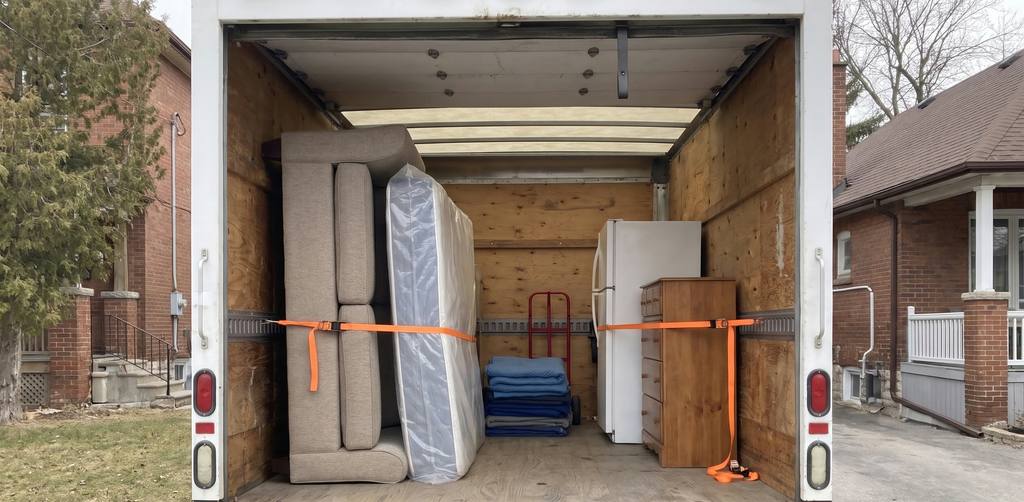
How a pickup works in North York
You send a list. We send a quote. We come with a box truck, carry everything out from where it sits, and sweep up.
From the list to the empty room
Send the list
Use the form. Say what the big items are, roughly how many bags or boxes, which floor they are on and what kind of place it is. If you have photos, say so and we will ask for them when we reply.
Get the quote
We reply by phone or email with a quote, or with a question if something in the list changes the job. The quote covers the carrying, the loading, the hauling and the disposal fees.
Pick the day
We agree on a day and an arrival window. In a building, this is the window your elevator is booked for.
We load
We check the items against the list with you, then carry them out. You do not have to move anything to the curb or the garage.
Swept and checked
We sweep where the pile was. You look at the space, and if we missed something, we take it then.
Sorted at the other end
Metal, electronics and anything hazardous are separated from the rest of the load before it is tipped, because the depots take them at different places and some are refused in a mixed load.
What decides the quote
We do not publish a price list. The same sofa is a ten-minute job in one house and a forty-minute job in another. These are the things that move the number.
- Space in the truck
- The biggest factor. We think of a load as a share of the box: a single item, a quarter, a half, a full truck.
- Weight
- Disposal is charged by weight at the transfer station. Furniture is light for its size. Tile, plaster, books, soil and wet carpet are not.
- The carry
- Stairs, tight turns, a long walk from the unit to the dock, or a backyard with no gate wide enough for a dolly.
- Taking things apart
- A wall unit, a bunk bed, a shed, a trampoline.
- Items with their own handling
- Fridges and freezers, mattresses, paint and other hazardous waste, concrete and soil.
- The building
- An elevator window, a loading dock that has to be booked, a height limit in the garage.
It goes a little differently by kind of place
Where the truck parks
A driveway is best. When there is none, these are the City rules that apply to a truck at the curb in North York. They come from the traffic and parking chapter of the municipal code.
- Three hours
- No vehicle may park on any street for more than three hours unless a sign says otherwise. A normal pickup is well inside that.
Source: Toronto Municipal Code, Chapter 950, Traffic and Parking
- Driveways and hydrants
- No parking in front of a driveway or within 60 centimetres of one, within three metres of a fire hydrant or within nine metres of an intersection.
Source: Toronto Municipal Code, Chapter 950, Traffic and Parking
- Signed main roads
- Where signs prohibit stopping in rush hour, that means 6 to 10 a.m. and 3 to 7 p.m. on weekdays. If your building fronts a road like that, tell us where the side entrance or the lane is.
Source: Toronto Municipal Code, Chapter 950, Traffic and Parking
- Winter nights
- In the former City of North York, some streets have no parking from 2 to 6 a.m. between December 1 and March 31. It applies only to the streets listed in the by-law schedule, and it does not affect a daytime pickup.
- Loading hours
- The noise by-law restricts loading and unloading noise from 11 p.m. to 7 a.m., and until 9 a.m. on Saturdays, Sundays and holidays.
We did not find a City permit made for a hauling or moving truck. Temporary parking permits exist only in permit-parking areas.
Before we arrive
You do not have to carry anything. These few things save time on the day.
- Pull out or mark anything that is staying
- Empty fridges, freezers, dressers and filing cabinets
- Shut off water to a washer or a fridge with an ice maker
- Have gas appliances disconnected
- Clear a path from the items to the door
- Keep pets in another room while the doors are propped open
- In a building, confirm the elevator booking the day before
Questions about how it works
How do I start arranging a North York junk pickup?
Use the form. Say what the big items are, roughly how many bags or boxes, which floor they are on and what kind of place it is. If you have photos, say so and we will ask for them when we reply.
We reply by phone or email with a quote, or with a question if something in the list changes the job. The quote covers the carrying, the loading, the hauling and the disposal fees.
We agree on a day and an arrival window. In a building, this is the window your elevator is booked for.
When are the contents and carrying work agreed?
We do not publish a price list. The same sofa is a ten-minute job in one house and a forty-minute job in another. These are the things that move the number.
The biggest factor. We think of a load as a share of the box: a single item, a quarter, a half, a full truck.
Disposal is charged by weight at the transfer station. Furniture is light for its size. Tile, plaster, books, soil and wet carpet are not.
What if the pile is different when the pickup is planned?
A driveway is best. When there is none, these are the City rules that apply to a truck at the curb in North York. They come from the traffic and parking chapter of the municipal code.
No vehicle may park on any street for more than three hours unless a sign says otherwise. A normal pickup is well inside that.
No parking in front of a driveway or within 60 centimetres of one, within three metres of a fire hydrant or within nine metres of an intersection.
Start with the list
What it is, how much, which floor. We reply with a quote.